
LinkedIn Pinpoint Answer 705
LinkedIn Pinpoint #705 Answer & Explanation
The clues for LinkedIn Pinpoint 705 are Toothpaste, Copper pipes, 365-day (solar) calendar, Papyrus, Heiroglyphs (𓂀𓋹𓅓). What connects these five clues? Scroll down to find the answer and solution.
LinkedIn Pinpoint 705 Clues & Answer (2026-04-05)
# LinkedIn Pinpoint 705 Answer 👇
# LinkedIn Pinpoint 705 Clues: Toothpaste, Copper pipes, 365-day (solar) calendar, Papyrus, Heiroglyphs (𓂀𓋹𓅓)
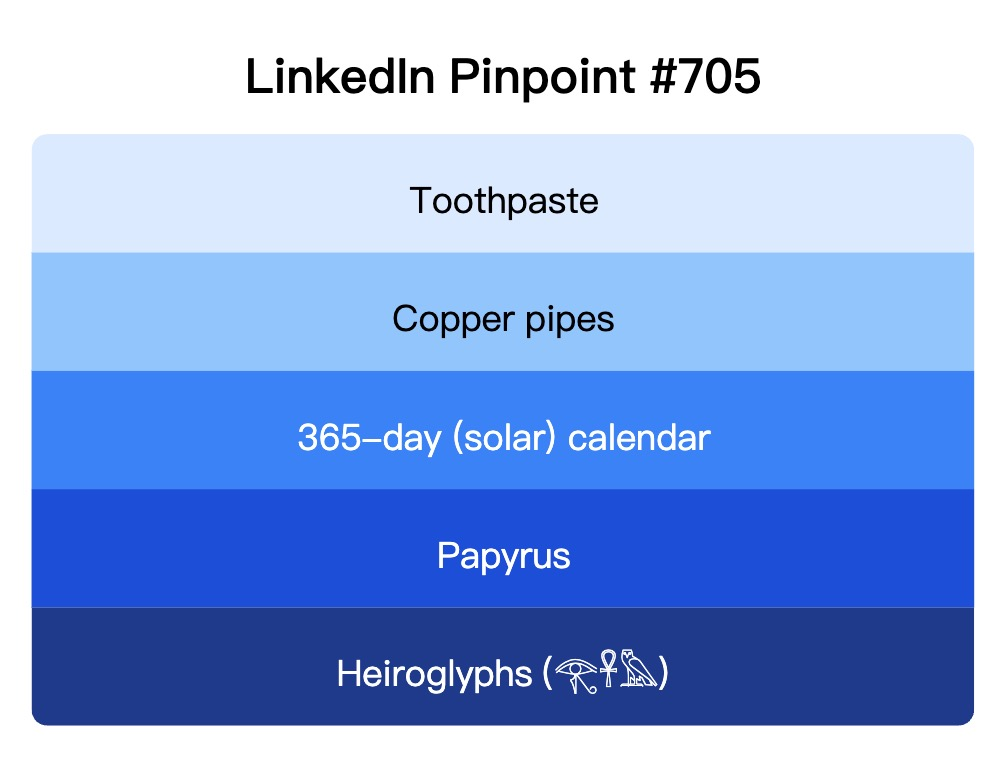
Process to Solve LinkedIn Pinpoint 705
I started with the clue Toothpaste and initially thought it was related to ancient civilizations in general, but I wasn't sure which one specifically. I moved on to Copper pipes, which seemed like an interesting combination with toothpaste. At this point, I was stumped, and my brain went to all sorts of places, thinking maybe it was about ancient technologies or innovations.
However, when I saw the 365-day (solar) calendar clue, something clicked. I realized that all these clues might be connected to a specific ancient civilization. I started to suspect that it was about ancient Egypt, but I wasn't entirely sure yet.
The next clue, Papyrus, solidified my suspicion. I remembered learning about papyrus being used in ancient Egypt, and I started to feel a sense of excitement. I was close to solving it!
When I saw the final clue, Heiroglyphs, I knew I had it. The connection was clear: all these inventions and innovations originated in ancient Egypt. It was a thrilling moment, and I felt proud of myself for piecing it together.
Looking back, it's amazing how all these clues fit together so perfectly. Ancient Egypt was truly a hub of innovation and ingenuity, and it's incredible to think about the impact their discoveries had on modern society.
Detailed Explanation of LinkedIn Pinpoint 705
| Clue | Explanation |
|---|---|
| Toothpaste | Toothpaste is believed to have been first created by the ancient Egyptians around 2500 BC. They used a mixture of ground pumice stone and vinegar to clean their teeth. |
| Copper pipes | The use of copper pipes dates back to ancient Egypt around 2500 BC. They used copper for plumbing and other applications, showcasing their advanced knowledge of metalworking. |
| 365-day (solar) calendar | The ancient Egyptians developed a 365-day (solar) calendar, which is the basis for the modern calendar used today. This innovation allowed for more accurate timekeeping and seasonal predictions. |
| Papyrus | Papyrus was first produced in ancient Egypt around 2500 BC. This writing material was made from the pith of the papyrus plant and was a significant invention for recording history, literature, and other written works. |
| Heiroglyphs | Heiroglyphs were a writing system used by the ancient Egyptians from around 3050 BC. This complex system of pictorial symbols was used to convey meaning and tell stories. |