
LinkedIn Pinpoint Answer 753
LinkedIn Pinpoint #753 Answer & Explanation
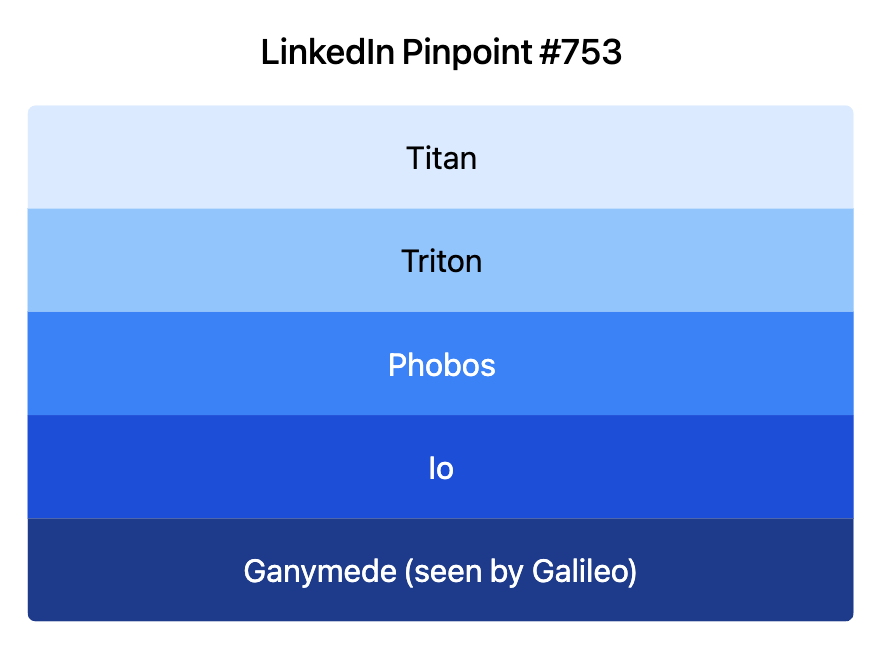
The clues for LinkedIn Pinpoint 753 are Titan, Triton, Phobos, Io, Ganymede (seen by Galileo). What connects these five clues? Scroll down to find the answer and solution.
LinkedIn Pinpoint 753 Clues & Answer (2026-05-23)
# LinkedIn Pinpoint 753 Answer 👇
# LinkedIn Pinpoint 753 Clues: Titan, Triton, Phobos, Io, Ganymede (seen by Galileo)
Process to Solve LinkedIn Pinpoint 753
I approached this puzzle with a mix of excitement and trepidation, given the variety of words that seemed unrelated at first glance.
My brain went straight to Titan, thinking it might be about planets or celestial bodies, but I couldn't quite place it in a larger context. Then, Triton popped up, and my mind wandered to the possibility of it being about Neptunian moons, but that seemed too specific.
The introduction of Phobos made me pivot towards considering smaller bodies orbiting planets, but the connection was still fuzzy. However, when Io appeared, something clicked. The variety of moons from different planets made me realize that the category might be broader than I initially thought.
It wasn't until I saw Ganymede that the entire puzzle came together. The fact that it was discovered by Galileo and is a moon of Jupiter solidified the connection between all the clues. The 'Aha!' moment was exhilarating - the category was about moons in our solar system!
With the category revealed, the remaining clues fit perfectly into place, each one highlighting a unique aspect of moons in our solar system. Reflecting on it, the diversity of the moons mentioned is a testament to the complexity and beauty of our celestial neighborhood.
Detailed Explanation of LinkedIn Pinpoint 753
| Clue | Explanation |
|---|---|
| Titan | Titan is the largest moon of Saturn and the second-largest moon in the solar system. |
| Triton | Triton is the largest moon of Neptune, known for its unique retrograde orbit and icy surface. |
| Phobos | Phobos is one of the two small moons of Mars, characterized by its irregular shape and close orbit to the planet. |
| Io | Io is the innermost of the four largest moons of Jupiter, known for its intense volcanic activity and unique orbital resonance with other moons. |
| Ganymede | Ganymede, discovered by Galileo, is the largest moon of Jupiter and the largest moon in the solar system, with a subsurface ocean and possible habitability. |